

.png)
Enterprise teams are not short on data, dashboards, or ideas. They are short on focus..
Most leaders have heard some version of this guidance: focus on what is actionable, not what is interesting. That mindset has helped analytics teams mature. Today, many organizations can quickly identify actions tied to metrics and execute them efficiently.
The issue is that actionability alone is a low bar.
Just because something can be optimized does not mean it should be–at least not today. Without a clear strategic filter, teams end up busy but misaligned, delivering activity without impact.
The Real Cost of Random Optimization
Random acts of optimization show up everywhere.
A workflow gets automated and saves a few hours a week.
An A/B test improves checkout conversion by a few points.
A model predicts upsell opportunities in a narrow segment with impressive accuracy.
Each of these looks like progress in isolation. Together, they often hide a bigger problem. Leaders confuse measurable improvement with meaningful progress.
The real questions tend to go unasked:
- What will we actually do with the time we saved?
- Is this metric tied to our most urgent business risk?
- Does this segment matter to revenue or growth this year?
If an improvement does not remove a real constraint on a strategic goal, it improves a process, not the business.
Incremental gains still matter. But without prioritization, they create opportunity cost. Teams invest time and budget in green metrics while red ones quietly erode value elsewhere.
Strategy Has to Come First
You cannot analyze your way into a strategy. Strategy has to direct the analysis.
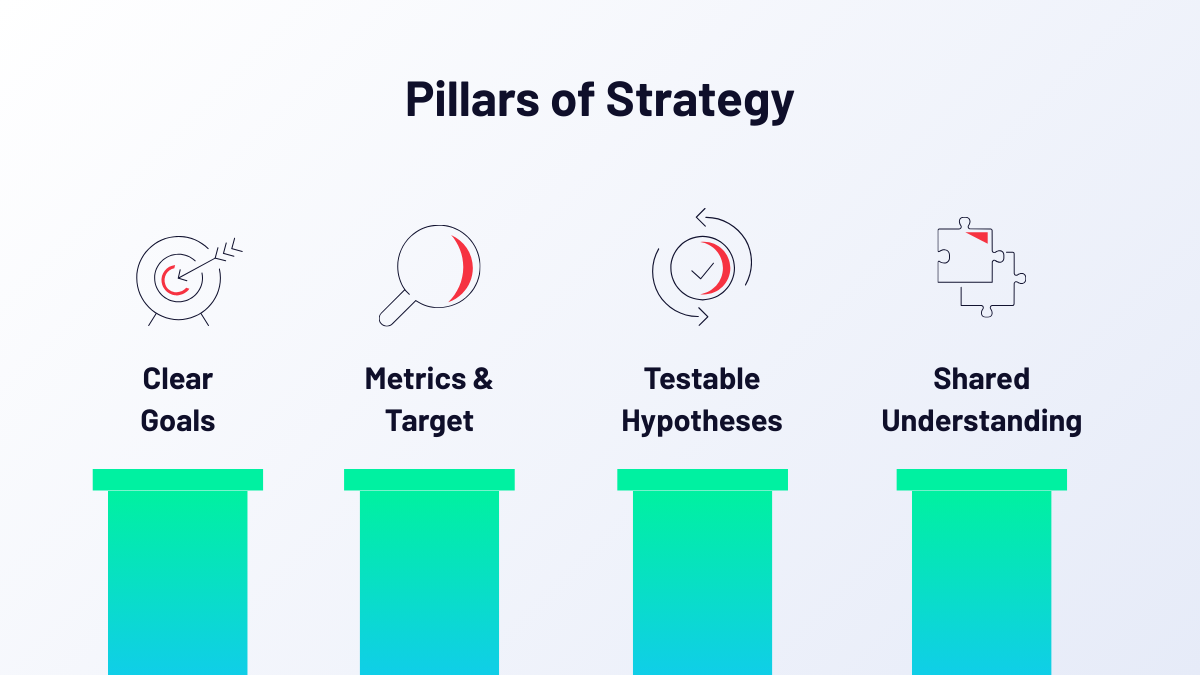
Organizations that avoid random optimization start with four fundamentals before the data work begins:
Clear Goals
Everyone must agree on what the organization is trying to achieve, not just at a high level but in practical terms.
Metrics and Targets
Goals become real only when success is measurable and owned. Metrics and targets provide the guardrails.
Testable Hypotheses
Data work should be intentional. Teams need to be explicit about what they believe will drive outcomes and why, so effort can be prioritized and validated.
Shared Understanding
Leadership and teams must align on what is known, what is unknown, and what needs to be learned next.
Without these, even the best data teams end up reacting to requests instead of driving outcomes.
From Reporting to Direction
When strategy leads, the role of data changes.
Requests for new analyses, experiments, or tools are evaluated against clear priorities. Leaders can quickly assess tradeoffs and focus resources where the business is most exposed or has the most upside.
This creates a shift:
- From reactive reporting → proactive course correction
- From backlog-driven work → outcome-driven decisions
- From asking what the data says → asking what the business needs solved
For regulated, data-intensive industries, this alignment is not optional. It is how organizations reduce risk, build trust, and scale responsibly.
Where Further Fits
Most organizations struggle to create this alignment on their own. Functional silos, competing incentives, and legacy metrics make it hard to agree on priorities.
This is where Further operates.
We help leaders put a strategic layer around their data and analytics so effort is focused on what actually matters. Not more dashboards. Not more metrics. Clear direction, shared priorities, and decisions that move the business forward.
Our work is grounded in real enterprise environments, where governance, privacy, and scale are just as important as insight.
Stop Optimizing in Isolation
Actionable insights are a starting point. Strategic alignment is the goal.
If your teams are busy but progress feels unclear, or if you are unsure which signals deserve attention and which can wait, it may be time to reset the strategy that guides your data.
Explore our case studies or connect with Further to see how we help leaders align data, AI, and business outcomes.



.png)
